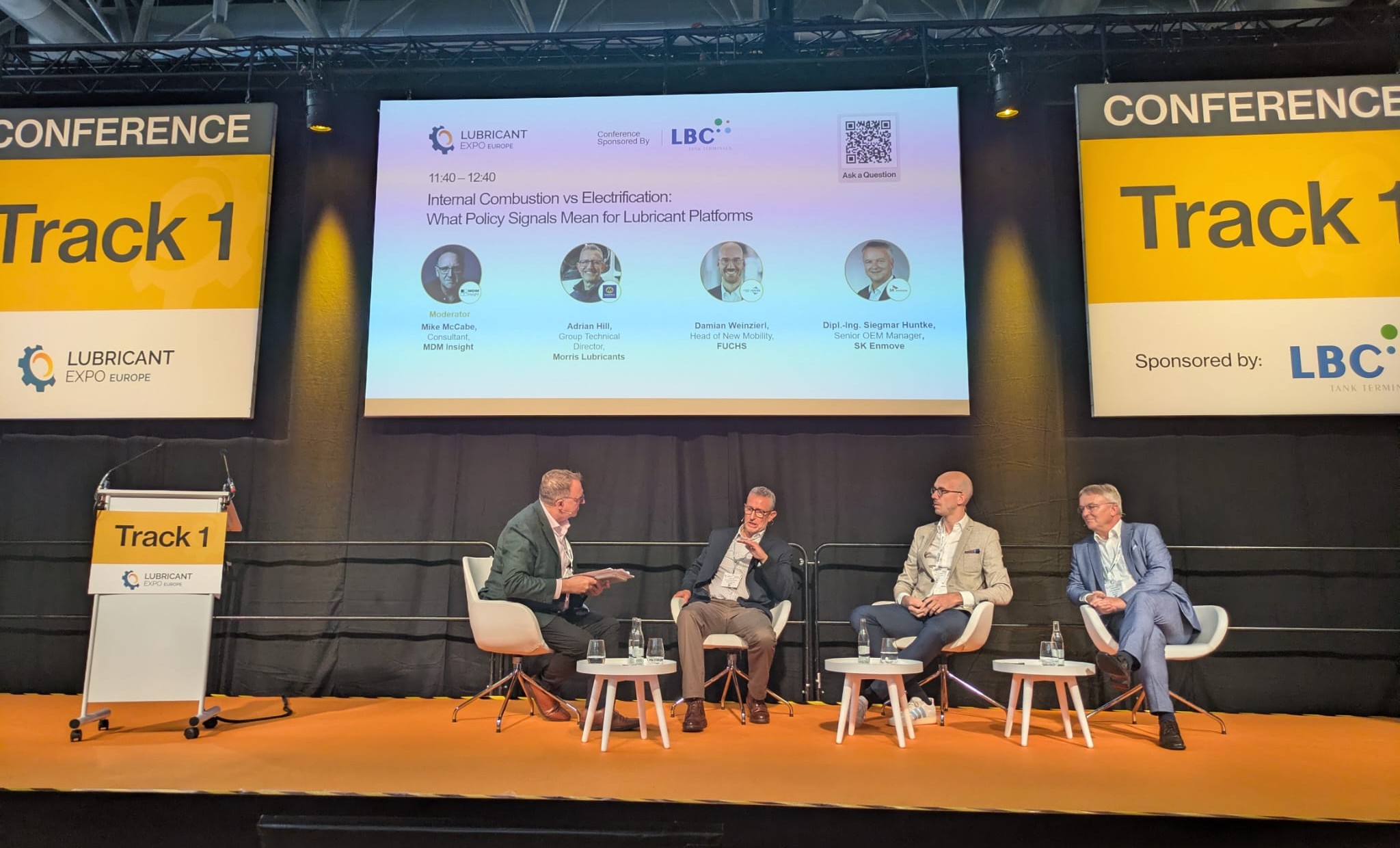
Technical Director Adrian Hill Shares his Expertise at Lubricant Expo Europe
Morris Lubricants’ Technical Director, Adrian Hill recently attended Lubricant Expo Europe in Dusseldorf, Germany. The event was an excellent opportunity for lubricant manufacturers, testing analysts, condition monitoring specialists, equipment providers, and raw material and additive suppliers to connect, collaborate and review the lubricant value chain. Whilst this was a great opportunity to meet with some of Morris Lubricant’s key stakeholders, Adrian was also excited to share his expertise as a panellist in the discussion “Internal Combustion vs Electrification: What Policy Signals Mean for Lubricant Platforms”.
The discussion focused on how evolving government policies, regulations and market incentives were affecting the pace and structure of Original Equipment Manufacturer (OEM) electrification strategies. Adrian explains, “In my view the OEMs have a strategy and a timeline already in place, which, in reality, may be ahead of government policy. The development of new technologies cannot wait for the latest regulations as this can be a lengthy process from design to trialling to sign-off and commercialisation. The signposts are already there, and policy can only be moving in one direction. The OEMs know what will be expected of them, and healthy competition will push innovation at an ever-increasing rate.”
Morris Lubricants will have to be agile and responsive to these changes, when it comes to formulating new oils and lubricants. Adrian elaborates: “New regulations result in new technology platforms, which will lead to a new aftermarket landscape. The rate of change is fast, and what felt perhaps five years ago like a very sketchy framework of fluid requirements and servicing regimes is starting to emerge from the mist. As Morris Lubricants collects the required data the next steps can be planned, but being left behind is simply not an option.”
Another focus of the panel discussion was how the lubricants industry can continue to support legacy vehicle technologies. Adrian continues: “We have to be realistic and be prepared to offer older technology lubricants into what is still a growing vehicle park. More traditional powertrains using Internal Combustion Engines (ICEs) still make up a large part of the aftermarket. To reduce material inventories, newer additive technology may still service this older vehicle park, possibly with down-treats or boosters. It is important not to forget that our main focus tends to be what is happening in Europe, but overseas territories are at different stages of evolution, and what we refer to as legacy vehicles will still be very relevant in certain countries.”
Reduced serviceability and longer-life components look set to have implications on end-of-life treatment and sustainability outcomes. Adrian explains: “There is no doubt that the cost of ownership and reduced environmental impact will drive the service industry down a different path, and Morris Lubricants’ traditional product portfolio will have to adapt. EV coolants and e-transmission fluids will definitely be on horizon as demand increases. This may not account for the shortfall in more traditional lubricant sales as time moves on, but I think we are yet to see what disruptive technologies are heading our way and what opportunities they may present us.”