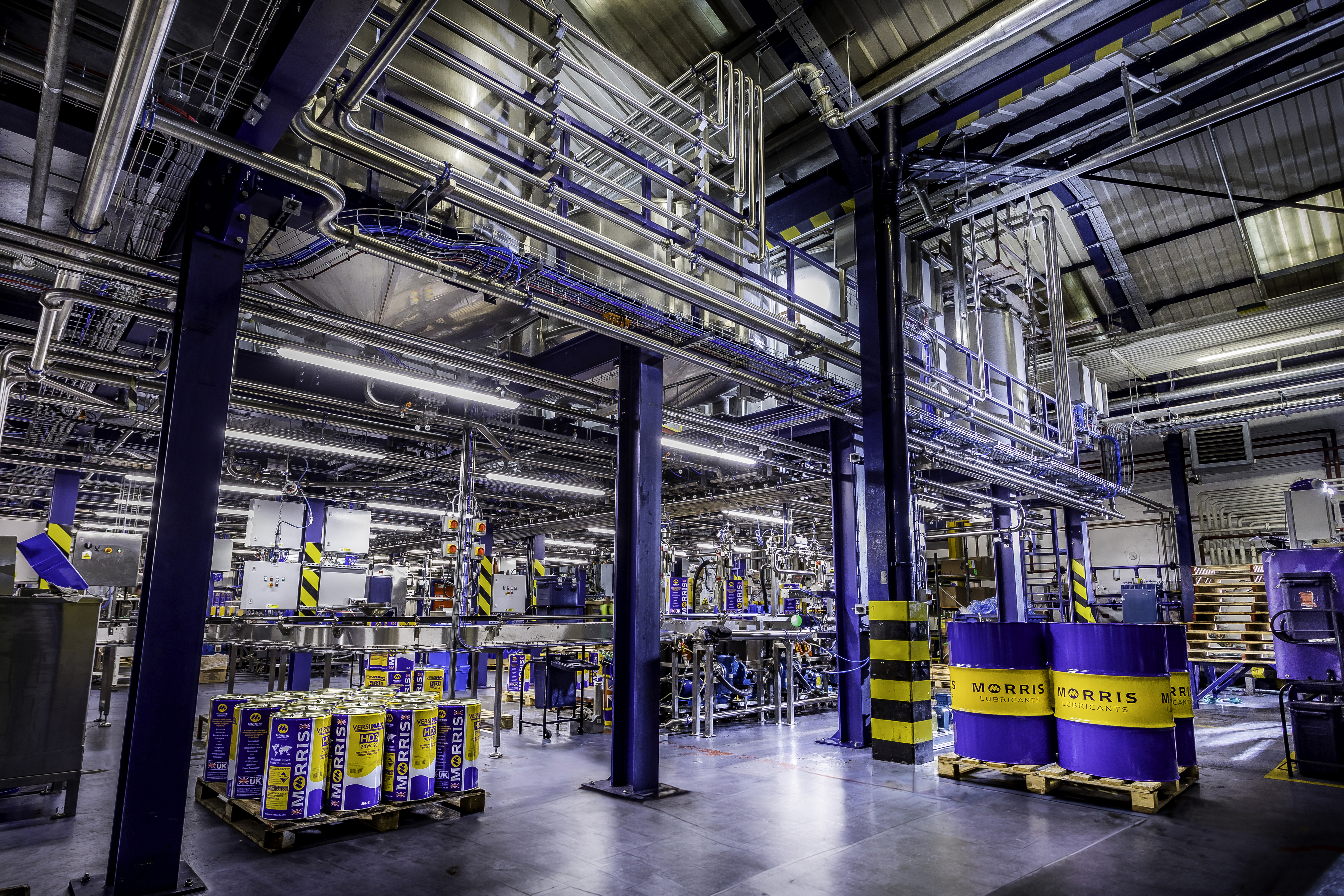
Major Capital Investment In Production Facilities at Morris Lubricants
Business and organisations, no matter what industry they operate in, cannot stand still. To be ready, you must get ahead, and following a £3m investment at the Shrewsbury production facility, Morris Lubricants is now more equipped to meet the demands of a rapidly changing lubricants industry. The days of having one oil fits all engine types and small selection product lines are long gone.
After years of planning, designing, and scheduling the build, phase one of the new production facility has been completed, tested and is now fully operational. This new facility sees it optimised for the sustainable manufacture of sophisticated small-batch formulations.
The design and development of the new facility is in response to customer requirements and with a backdrop of optimising the manufacture of sophisticated small-batch product formulations in a more sustainable way. The company believes it now has one of the most technologically advanced and flexible oil blending capabilities in Europe.
This £3 million investment demonstrates Morris Lubricants’ commitment to manufacturing and producing high quality oils and lubricants for customers around the world.
As well as the increased efficiency, reduced energy use and optimised workflows, one of the major benefits of this new facility is the increased flexibility. This means that smaller volumes of high-quality products can be manufactured to the specifications expected by customers, demanded by the OEMs and stipulated by industry regulations.
“It’s my role to ensure the business is fit for purpose and reacting to our environment.” explains Andrew Goddard, Morris Lubricants’ Executive Chairman, who regards the “ever evolving” challenge of creating a more diverse and technically complex range of products as an opportunity for Morris Lubricants to do what it does best.
“Moving with the times is something we’ve done for over 150 years and this project has enabled us to ensure we are at the very leading edge of technological advancements so that we can continue to provide the quality and service our customers have a right to expect from us.” says Andrew.
With a focus on efficiency and flexibility, as well as the mitigation of carbon emissions and the reduction of waste within operations, improvements to the production plant have included the installation of a new tank farm comprising thirty stainless steel storage vessels, the relocation and reconfiguration of production lines, and the integration of a state-of-the art, fully automated control and recovery system. The installation of the tank farm can be seen in the stop motion video below.
As well as the huge capital investment in new pieces of manufacturing equipment, investigation of the workflows on the factory floor took place over two years to establish the most efficient ways of working. This investment in equipment, monitoring and analysis has resulted in uplifted levels of productivity by significantly reducing transfer times of raw material, packaging and finished product, as well as lessening the amount of wasteful double handling.
“The benefits have been felt immediately and it’s working as it was designed to.”, says Andrew. “In addition to delivering labour and logistics efficiencies, which ensure we can provide the best value for our customers,” Andrew adds, “the changes have also led to a reduction in waste, and with sustainable practices central to the plant’s redesign, low energy LED lamps have also been fitted throughout the production facility.” This investment builds upon the existing sustainable solutions which includes onsite solar power generated electricity, ultrasonic product blending capabilities, the removal of unnecessary dye in in some products, the use of recyclable packaging and the introduction of recycled plastic bottles.
Morris Lubricants has a reputation that is built on excellence, service flexibility and rigorous quality-control standards, which have always been par for the course. To ensure the purity and quality of each product batch, at various stages of its manufacture, tests are performed and checked in the onsite Morris Lubricants’ Quality Control Laboratory. Around 5,000 tests are performed by the Quality Control Laboratory each month. To guarantee that Morris Lubricants’ wide variety of oils and lubricants sold each day meet the exacting and consistent standards customers rely on to protect their assets, there is no room for error. Andrew adds: “We have never and will never sacrifice the quality of our products so to keep competitive we must improve our own internal practices, which is what this investment is all about.”
To prevent cross-contamination when moving oils and lubricants between different areas of the plant, for example, strict procedures have always been in place. The improved and expanded infrastructure of stainless steel pipework – which features product specific pigged routes – combined with the advancements that have been made in regulating the different aspects of its operation through computerisation and automation, such as cleaning and waste recovery, further minimise the risk.
Andrew continues “Due to the hygienic nature of the pipework,” we now have the flexibility to transfer 600 different product combinations from source to destination without disruption, whereas before, product compatibility would play a big part when transferring and storing product.”
Part of the masterplan is to facilitate the repeat manufacture of the more bespoke formulations that industry regulations stipulate and OEMs require. This ability to maintain the flow of production means that Morris Lubricants can manufacture multiple grades simultaneously. A small-batch production run of 2,000 litres, which can be filled in less than 40 minutes, can be processed at the same time as a batch comprising of 100,000 litres.
“This makes us more flexible and has meant a faster introduction process for new products,” says Technology Manager, Adrian Hill. Other vital steps have included an increase in the company’s inventory of raw materials and further investment in the Quality Control Laboratory to broaden its capability for testing the company’s innovative product formulations.
The fragmentation of the oil and lubricant market will continue as emission legislations tighten. The introduction of alternative fuel types such as hydrogen, e-fuels and synthetics, will also pose new challenges for the industry and formulation for oils, greases and other lubricants must meet these ever changing requirements.
Andrew concludes, “As technology and customer needs change, our service and product offering will change. We plan on being here for the long-term, so investing in the future has always been a priority. . Whatever the future brings Morris Lubricants will be well placed to supply whatever is needed.”
This is just phase one of a long-term plan and continual investment. More information is to follow in the next few months.